재미있는 한국어jaemiinneun hangugeo

Fun Korean

Hangul, life in Korea, travel, history and short lessons.

Korean Food Tour: Famous Markets and Food Streets

Famous Korean food markets and streets and what to eat there, with 5 Korean phrases for ordering, with audio and a quick quiz.

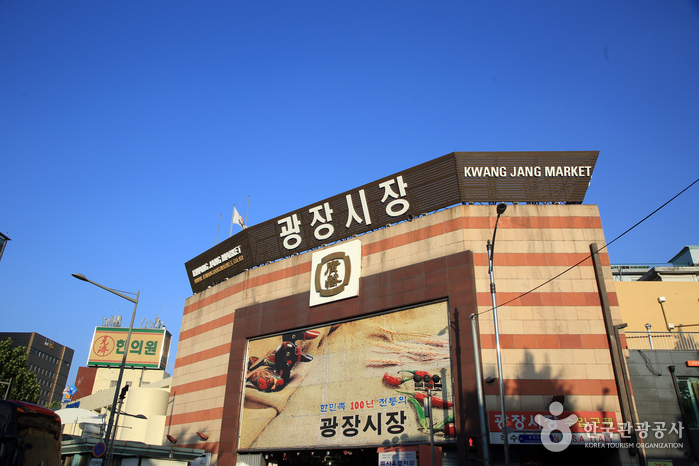
  • Gwangjang Market (광장시장)
    Data: Korea Tourism Organization (한국관광공사)
    Seoul · Jongno-gu

    Gwangjang Market

    광장시장

    One of Korea's oldest markets, founded in 1905. In the food alley at its center, stalls fry bindaetteok (crispy mung bean pancakes) to order. Also try mayak gimbap (small gimbap rolls) and yukhoe (seasoned raw beef). Sit at a counter, point and order.

    Busiest in the evening and on weekends. Jongno 5-ga Station (Line 1).

  • Jagalchi Fish Market (자갈치시장)
    Data: Korea Tourism Organization (한국관광공사)
    Busan · Jung-gu (Nampo-dong)

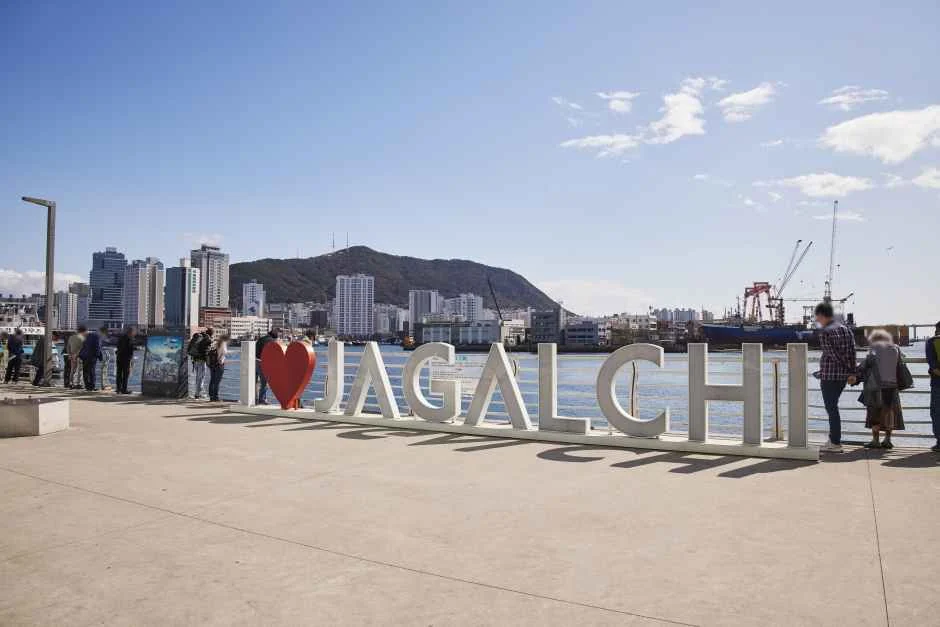
    Jagalchi Fish Market

    자갈치시장

    Korea's best-known seafood market, on the harbor in Nampo-dong. Choose live fish, octopus or shellfish at the ground-floor stalls. The restaurants upstairs serve it as hoe (sliced raw fish) or cook it into a spicy stew. BIFF Square and Gukje Market are a short walk away.

    Upstairs restaurants usually charge a small table and service fee per person. Jagalchi Station (Line 1).

    Unconfirmed: The table fee varies by restaurant. Check before you sit down.

  • Mangwon Market (망원시장)
    Data: Korea Tourism Organization (한국관광공사)
    Seoul · Mapo-gu

    Mangwon Market

    망원시장

    A busy neighborhood market near the Han River, loved for cheap, tasty snacks: crispy dakgangjeong (sweet fried chicken), croquettes, fried peppers and fresh fruit. Fill a bag and walk to Mangwon Hangang Park for a riverside picnic.

    Mangwon Station, Line 6.

  • Tongin Market (Coin Lunchbox) (통인시장)
    Data: Korea Tourism Organization (한국관광공사)
    Seoul · Jongno-gu

    Tongin Market (Coin Lunchbox)

    통인시장

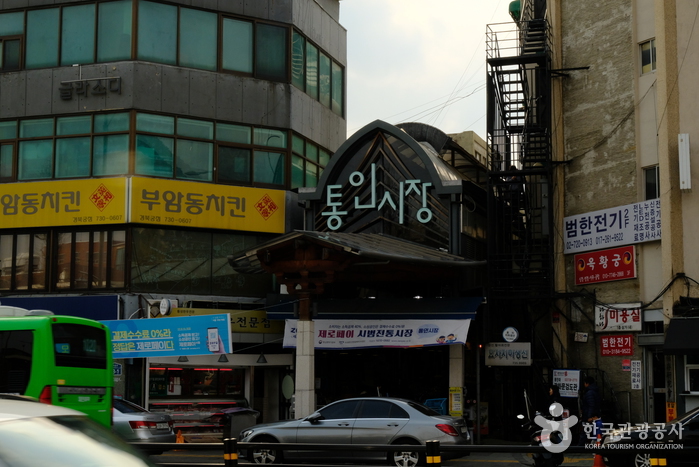
    A small market near Gyeongbokgung, open since 1941 and famous for its Dosirak Café. Swap cash for old-style brass coins (yeopjeon), pick up a lunchbox tray and fill it with dishes from the stalls. Don't miss gireum tteokbokki: rice cakes stir-fried in oil and chili.

    Gyeongbokgung Station, Line 3. Pair it with the palace or Seochon's cafés.

  • BIFF Square Ssiat Hotteok (BIFF광장 씨앗호떡)
    Data: Korea Tourism Organization (한국관광공사)
    Busan · Jung-gu

    BIFF Square Ssiat Hotteok

    BIFF광장 씨앗호떡

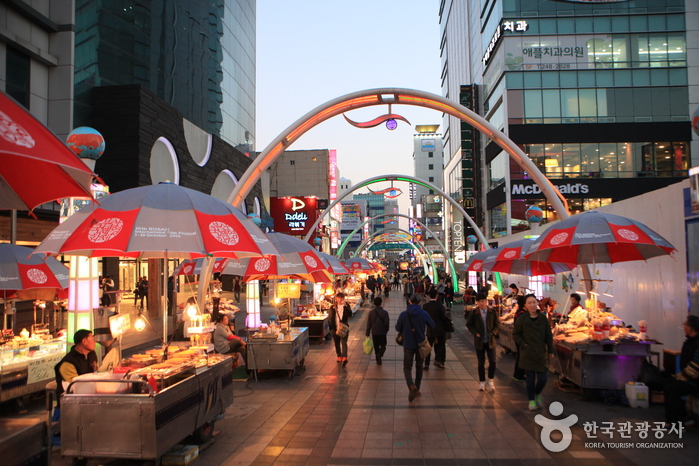
    BIFF Square in Nampo-dong is where the Busan International Film Festival began in 1996, with film stars' handprints set into the pavement. Its street stalls are famous for ssiat hotteok: a fried sweet pancake split open and stuffed with sunflower seeds, pumpkin seeds and nuts.

    Jagalchi Market and Gukje Market are next door. Nampo Station, Line 1.

  • Jeonju Nambu Market Night Market (전주 남부시장 야시장)
    Data: Korea Tourism Organization (한국관광공사)
    Jeonju, Jeollabuk-do

    Jeonju Nambu Market Night Market

    전주 남부시장 야시장

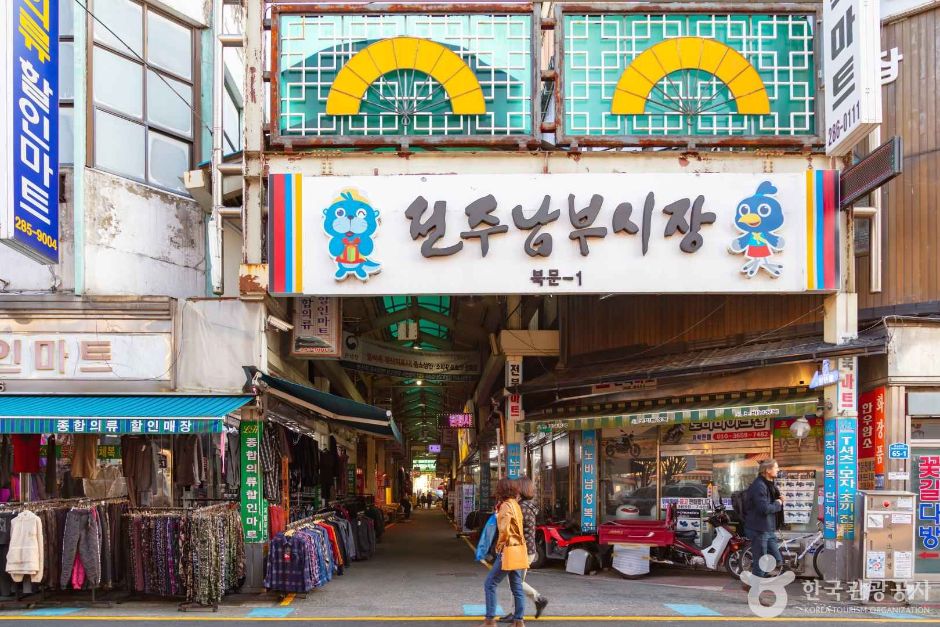
    Jeonju's main market, open since 1905, a short walk from the hanok village. On Friday and Saturday evenings the night market fills the aisles with food stalls, from mung bean pancakes to fusion snacks. Upstairs, the Youth Market has small shops and cafés run by young owners.

    Jeonju is famous for kongnamul gukbap (bean sprout soup with rice), a classic market breakfast.

    Unconfirmed: The night market runs on Fridays and Saturdays; hours change by season.

  • Jeju Dongmun Market (제주 동문시장)
    Data: Korea Tourism Organization (한국관광공사)
    Jeju · Jeju-si

    Jeju Dongmun Market

    제주 동문시장

    Jeju's biggest traditional market, trading since 1945. Shop for tangerines, hallabong, black pork and fresh cutlassfish, and come back in the evening when the night market's food stalls open.

    About 15 minutes from Jeju Airport by car. Many fruit stalls can ship boxes within Korea.

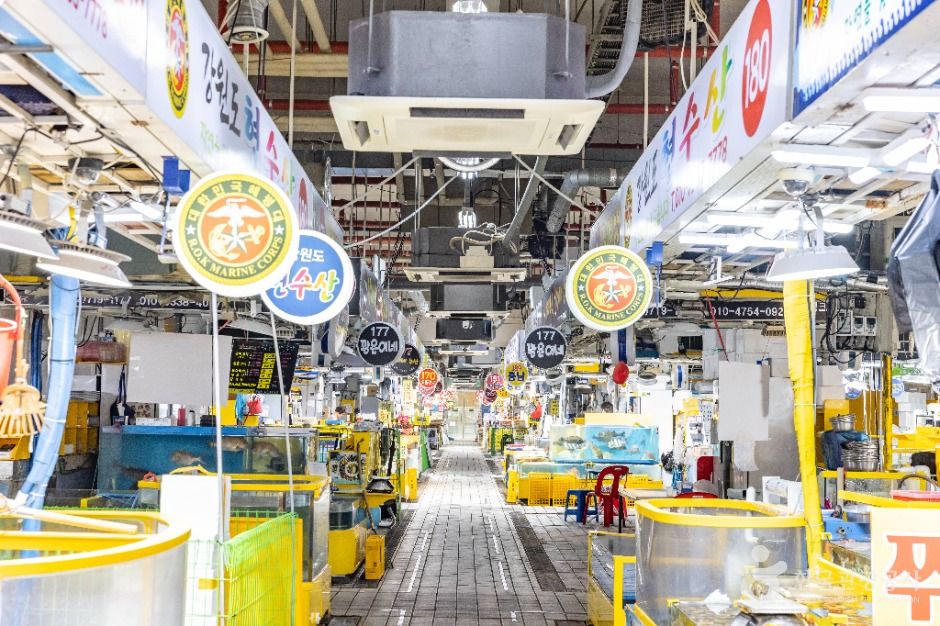
  • Sokcho Tourist & Fishery Market (속초관광수산시장)
    Data: Korea Tourism Organization (한국관광공사)
    Sokcho, Gangwon-do

    Sokcho Tourist & Fishery Market

    속초관광수산시장

    Sokcho's big market, formerly called Jungang Market. Its chicken alley is famous for dakgangjeong, crispy fried chicken in a sweet and spicy glaze, sold by the box to take away. The raw fish center sells the day's catch, and you'll also find squid sundae (stuffed squid) and dried seafood.

    Easy to pair with Seoraksan: local buses run between Sokcho and the park.

  • Daegu Seomun Market Night Market (대구 서문시장 야시장)
    Data: Korea Tourism Organization (한국관광공사)
    Daegu · Jung-gu

    Daegu Seomun Market Night Market

    대구 서문시장 야시장

    One of the three great markets of the Joseon era and still Daegu's largest, known for fabrics and everyday goods. After dark, a long row of food stalls opens for the night market. In the market alleys, try Daegu's flat dumplings (napjak mandu) and kalguksu noodle soup.

    Unconfirmed: Night market days and hours change by season. Check before you go.

  • Chuncheon Dakgalbi Street (춘천 명동 닭갈비골목)
    Data: Korea Tourism Organization (한국관광공사)
    Chuncheon, Gangwon-do

    Chuncheon Dakgalbi Street

    춘천 명동 닭갈비골목

    A 150 m alley off Chuncheon's Myeong-dong shopping street, lined on both sides with dakgalbi restaurants. Spicy marinated chicken is stir-fried with cabbage, sweet potato and rice cakes on a big iron pan at your table. Finish with fried rice made in the same pan, or cold makguksu buckwheat noodles.

    Most places serve dakgalbi for two or more. ITX-Cheongchun trains run from Seoul to Chuncheon.

  • Gukje Market Food Street (국제시장 먹자골목)
    Data: Korea Tourism Organization (한국관광공사)
    Busan · Jung-gu

    Gukje Market Food Street

    국제시장 먹자골목

    A food street with more than 60 years of history in one of Busan's traditional markets. Sit on a small stool by the stalls and try Chungmu gimbap with spicy squid, tteokbokki, milmyeon (wheat noodles), dwaeji gukbap (pork and rice soup) or Busan's bibim dangmyeon (spicy glass noodles). Finish with patbingsu.

    Closed on the first and third Sundays of every month. Opening hours vary by stall.

  • Sindang-dong Tteokbokki Town (신당동 떡볶이골목)
    Data: Korea Tourism Organization (한국관광공사)
    Seoul · Jung-gu

    Sindang-dong Tteokbokki Town

    신당동 떡볶이골목

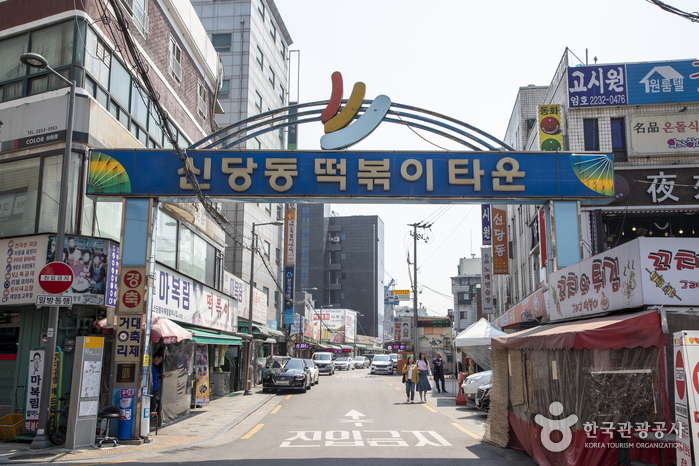
    An alley of tteokbokki restaurants that took off in the late 1970s and became famous in the 1980s, when shops had their own DJ booths. Some owners say tteokbokki was sold here as early as 1953.

    Parking is available at each restaurant.

  • Seoul Gyeongdong Market (서울 경동시장)
    Data: Korea Tourism Organization (한국관광공사)
    Seoul · Dongdaemun-gu

    Seoul Gyeongdong Market

    서울 경동시장

    A large traditional market near Cheongnyangni Station that grew after the Korean War and officially opened in June 1960. It is known for food ingredients and medicinal herbs. The old Gyeongdong Theater inside was renovated into a cultural space that draws a younger crowd.

    Busy on weekdays as well as weekends. Hours and closed days vary by store; no parking.

  • Sinpo International Market (신포국제시장)
    Data: Korea Tourism Organization (한국관광공사)
    Incheon · Jemulpo-gu

    Sinpo International Market

    신포국제시장

    A market in Incheon's Sinpo-dong said to date to the late 19th century, when it sold vegetables to Japanese, Chinese and Western residents. Close to the International Passenger Terminal, it has grown into a market of many cultures, with an information center that offers shopping and tourism help and interpretation.

    Hours and closed days vary by store. Parking and restrooms are available.

  • Sorae Fish Market (소래포구 종합어시장)
    Data: Korea Tourism Organization (한국관광공사)
    Incheon · Namdong-gu

    Sorae Fish Market

    소래포구 종합어시장

    A fish market by Sorae Port that sells fresh seafood all year. Crabs come fresh off the boats in spring, and in kimchi-making season many Koreans come for salted seafood (jeotgal). The market was renovated with heating and cooling, a large parking area and quick delivery.

    Open every day 07:00-01:00.

  • Jukdo Market (죽도시장)
    Data: Korea Tourism Organization (한국관광공사)
    Pohang, Gyeongsangbuk-do

    Jukdo Market

    죽도시장

    The largest traditional market on Korea's east coast, with about 1,500 stores, officially set up in 1969. Inside the seafood auction area, more than 200 hoe (raw fish) restaurants will prepare the seafood you buy for a small fee. Try Pohang's mulhoe (cold raw fish soup), abalone porridge, or gwamegi in winter.

    Open all year, 08:00-22:00.

  • Andong Market Jjimdak Alley (안동시장 찜닭골목)
    Data: Korea Tourism Organization (한국관광공사)
    Andong, Gyeongsangbuk-do

    Andong Market Jjimdak Alley

    안동시장 찜닭골목

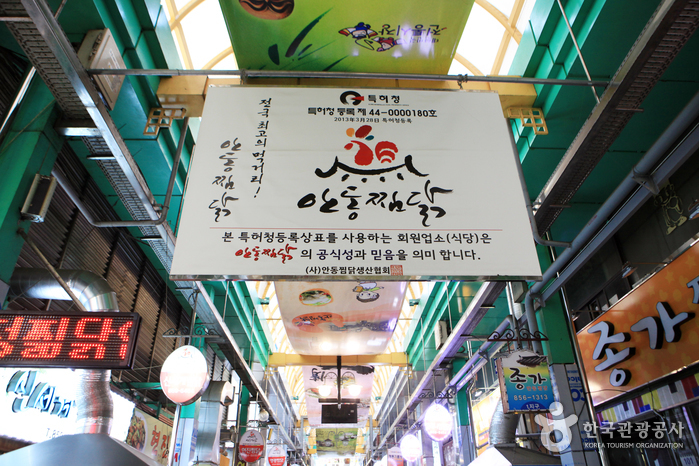
    A chicken alley in Andong's old market where Andong jjimdak was born: chicken braised in a galbi-style sauce, then cooked down with glass noodles and vegetables. Sweet, spicy, cheap and generous, it became a hit around the country. Some 30 restaurants line the alley today.

    Weekends are busy: the alley draws more than 20,000 visitors on a weekend.

  • Anjirang Gopchang Alley (안지랑 곱창골목)
    Data: Korea Tourism Organization (한국관광공사)
    Daegu · Nam-gu

    Anjirang Gopchang Alley

    안지랑 곱창골목

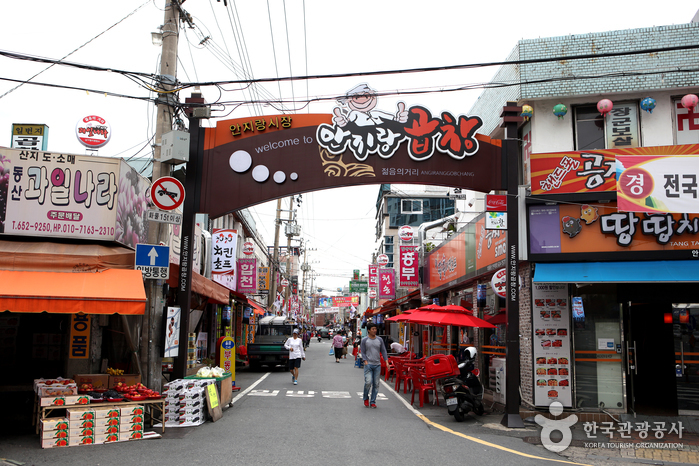
    An alley at Daegu's Anjirang Market packed with restaurants grilling marinated gopchang (intestines). It began with one restaurant in 1979 and kept growing; locals love it for the low prices. In 2012 it was picked as one of Korea's top five food-themed streets by the Ministry of Culture, Sports and Tourism.

    Parking is available.

  • Songjeong-dong Tteokgalbi Street (광주 송정동 떡갈비 골목)
    Data: Korea Tourism Organization (한국관광공사)
    Gwangju · Gwangsan-gu

    Songjeong-dong Tteokgalbi Street

    광주 송정동 떡갈비 골목

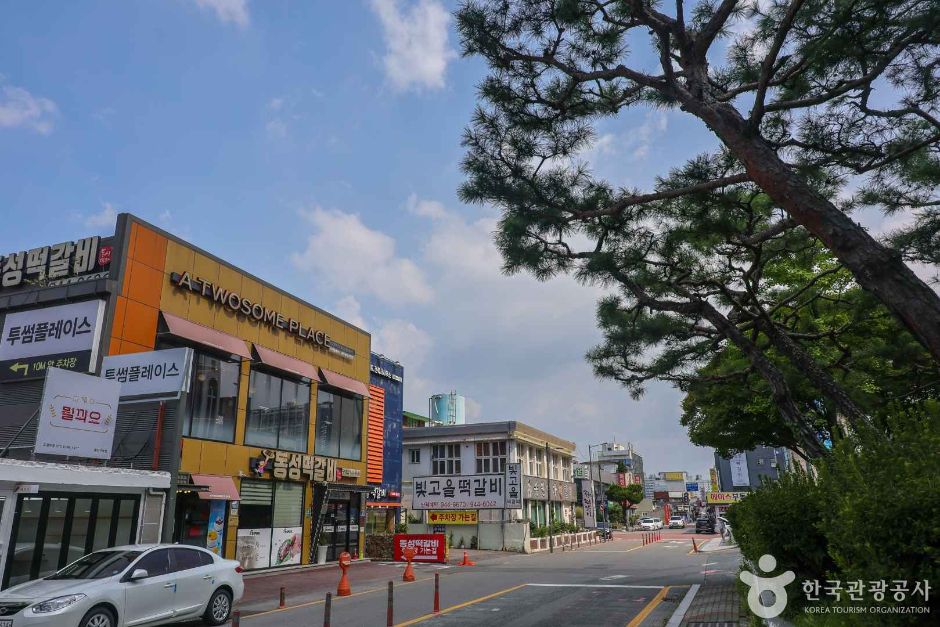
    A street of around 20 restaurants serving tteokgalbi, grilled patties of minced galbi. Unlike most places that use only beef, Songjeong-dong mixes beef and pork, a change made in the 1990s to keep prices the same in hard times. Meals come with a bone broth slow-cooked from pork bones, kelp and radish.

    Hours and closed days vary by restaurant.

  • Gyeongju Jungang Market (경주 중앙시장)
    Data: Korea Tourism Organization (한국관광공사)
    Gyeongju, Gyeongsangbuk-do

    Gyeongju Jungang Market

    경주 중앙시장

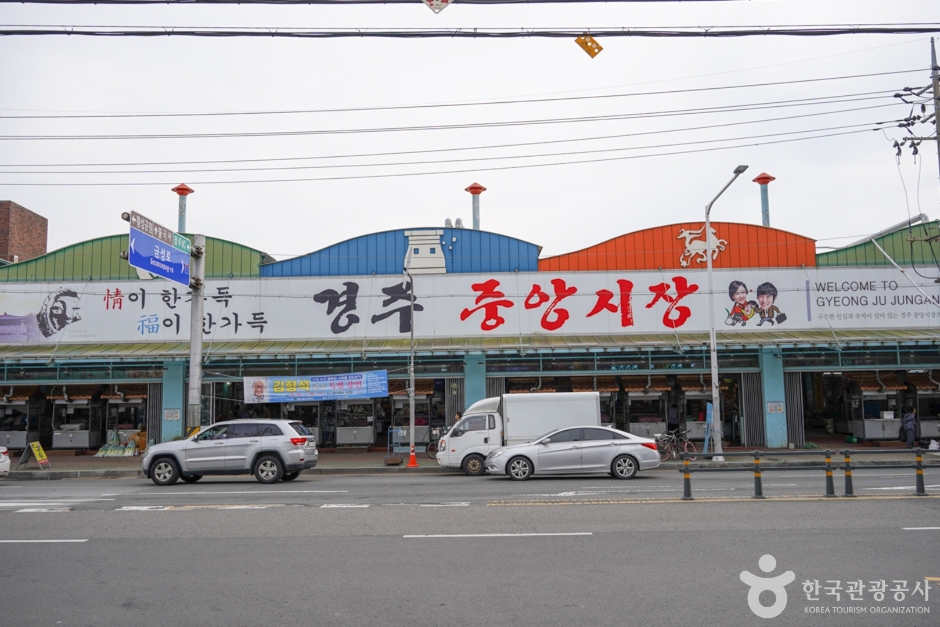
    Gyeongju's main market since 1983, with nearly 700 stores selling rice cakes, vegetables, meat, oils and more. It is busiest on days ending in 2 or 7, the traditional five-day market days. The night market, open Thursday to Sunday, is popular with visitors and locals alike.

    Open 05:00-22:30 (varies by store). Closed on the 1st and 15th of each month.

  • Uijeongbu Budae-jjigae Street (의정부 부대찌개거리)
    Data: Korea Tourism Organization (한국관광공사)
    Uijeongbu, Gyeonggi-do

    Uijeongbu Budae-jjigae Street

    의정부 부대찌개거리

    Budae-jjigae means "army base stew": after the Korean War, processed meat from US Army bases was boiled into a stew with vegetables, glass noodles and ramyeon. Uijeongbu, close to the bases, built a strong tradition of this sausage stew, and the restaurants that serve it gathered on this street, now a landmark of the city.

    Opening hours and days off vary by restaurant.

  • Seogwipo Maeil Olle Market (서귀포매일올레시장)
    Data: Korea Tourism Organization (한국관광공사)
    Jeju · Seogwipo

    Seogwipo Maeil Olle Market

    서귀포매일올레시장

    The largest market in Seogwipo, a traditional market that took shape in the early 1960s. Since a renewal that began in 2001 it stretches about 620 m and is easy to walk through. It sells local farm produce and seafood, offers free delivery, and holds cultural programs and outdoor shows.

    Open 07:00-21:00 in summer and 07:00-20:00 in winter, all year.

  • Tongyeong Jungang Market (통영 중앙시장)
    Data: Korea Tourism Organization (한국관광공사)
    Tongyeong, Gyeongsangnam-do

    Tongyeong Jungang Market

    통영 중앙시장

    A market with almost 400 years of history, next to Dongpirang Village and facing Gangguan Port, where replicas of the turtle ship are moored in honor of Admiral Yi Sun-sin. Being right by the sea, it is full of fresh and dried fish, and you can also find rice cakes, quilted goods and mother-of-pearl crafts.

    Opening hours and days off vary by store.

  • Gwangju Yangdong Market (광주 양동시장)
    Data: Korea Tourism Organization (한국관광공사)
    Gwangju · Seo-gu

    Gwangju Yangdong Market

    광주 양동시장

    It began in the 1910s as a market held on days ending in 2 and 7, on the sandy riverbank under Gwangjugyo Bridge. During the May 18 Democratic Uprising, its merchants gave food, drinks and medicine to the citizens and joined the movement. Today it is one of Korea's best-known traditional markets, selling fruit, vegetables, skate, chicken and much more.

    Open 07:00-21:00 (varies by store). Closed on the 1st, 3rd and 5th Sundays of the month.

  • Masan Odong-dong Agujjim Street (마산 오동동 아구찜거리)
    Data: Korea Tourism Organization (한국관광공사)
    Changwon, Gyeongsangnam-do

    Masan Odong-dong Agujjim Street

    마산 오동동 아구찜거리

    Masan is famous for agujjim, steamed monkfish: sweet, mild fish in a strong, spicy sauce with bean sprouts and greens. The street began in the 1960s, when a restaurant started steaming freshly caught monkfish with doenjang, gochujang and bean sprouts. Local fishermen loved it, more restaurants followed, and the street was born.

    Opening hours vary by restaurant.

  • Gijang Market (부산 기장시장)
    Data: Korea Tourism Organization (한국관광공사)
    Busan · Gijang-gun

    Gijang Market

    부산 기장시장

    An outdoor market selling seafood, dried fish and farm produce. Seaweed and anchovies are the stars in spring, and cutlass fish in autumn: the cutlass fish sold in the two months around Chuseok (Korean Thanksgiving) is known across the country for its taste and fair prices.

    Open 07:00-22:00, all year.

  • Daejeon Jungang Market (대전 중앙시장)
    Data: Korea Tourism Organization (한국관광공사)
    Daejeon · Dong-gu

    Daejeon Jungang Market

    대전 중앙시장

    One of Daejeon's best-known traditional markets, made up of several smaller markets in downtown Dong-gu. Each street has its own theme, such as dried seafood, fish, herbal medicine, hanbok and local treats, and together they run all the way from Daejeon Station to the banks of the Daejeoncheon Stream.

    Opening hours and days off vary by store.

  • Suwon Chicken Street (수원 통닭거리)
    Data: Korea Tourism Organization (한국관광공사)
    Suwon, Gyeonggi-do

    Suwon Chicken Street

    수원 통닭거리

    A 100 m alley off Paldal-ro where about 11 shops, from the first one, opened in 1970, to newer ones, fry whole chickens. The street's tradition is to fry the chicken in big cauldrons of oil. The menu is simple, fried or seasoned fried chicken, but generous portions and low prices bring in customers from all over the country.

    The street is open 24 hours, all year; each shop keeps its own hours.

  • Chodang Tofu Village (강릉 초당두부마을)
    Data: Korea Tourism Organization (한국관광공사)
    Gangneung, Gangwon-do

    Chodang Tofu Village

    강릉 초당두부마을

    Just south of Gyeongpo Beach, this village is famous for Chodang tofu, made from ground soybeans and seawater from the East Sea, which makes it soft and light. The name comes from Chodang Heo Yeop, father of the Joseon writers Heo Gyun and Heo Nanseolheon; a traditional house has been rebuilt where their family home once stood.

    Each restaurant keeps its own hours. Parking is available.

  • Haeundae Market (부산 해운대시장)
    Data: Korea Tourism Organization (한국관광공사)
    Busan · Haeundae-gu

    Haeundae Market

    부산 해운대시장

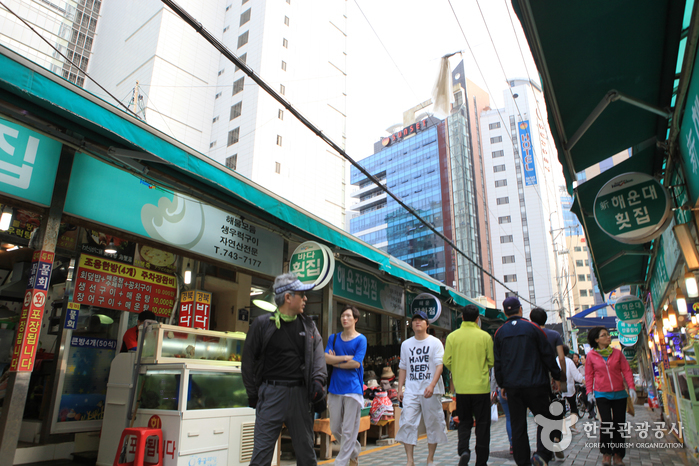
    A lively market a short walk from Haeundae Beach, busiest in the holiday seasons. Fresh vegetables, meat and seafood sell at low prices and there is plenty to eat. It is also known as "Sea Eel Alley", because the smell of grilled sea eel fills every corner.

    Open 09:00-22:00 (varies by store).

  • Dongdaemun Dak Hanmari Alley (서울 동대문 닭한마리 골목)
    Data: Korea Tourism Organization (한국관광공사)
    Seoul · Jongno-gu

    Dongdaemun Dak Hanmari Alley

    서울 동대문 닭한마리 골목

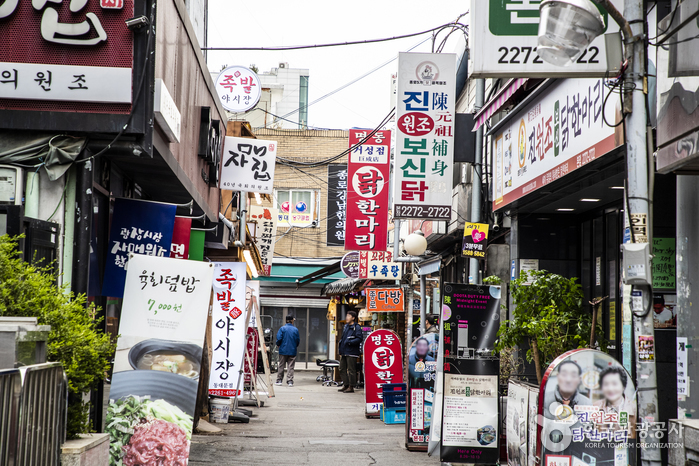
    An alley near Dongdaemun Market lined with restaurants serving dak hanmari, literally "one whole chicken": a whole chicken boiled in broth and eaten with the alley's special sauce. When the meat is gone, kalguksu noodles go into the same broth. The big clothing and fabric markets around it keep the area busy.

    Open 10:30-01:00 (next day), all year round. Parking is available.

  • Pyeonghwa Market Chicken Gizzard Alley (대구 평화시장 닭똥집 골목)
    Data: Korea Tourism Organization (한국관광공사)
    Daegu · Dong-gu

    Pyeonghwa Market Chicken Gizzard Alley

    대구 평화시장 닭똥집 골목

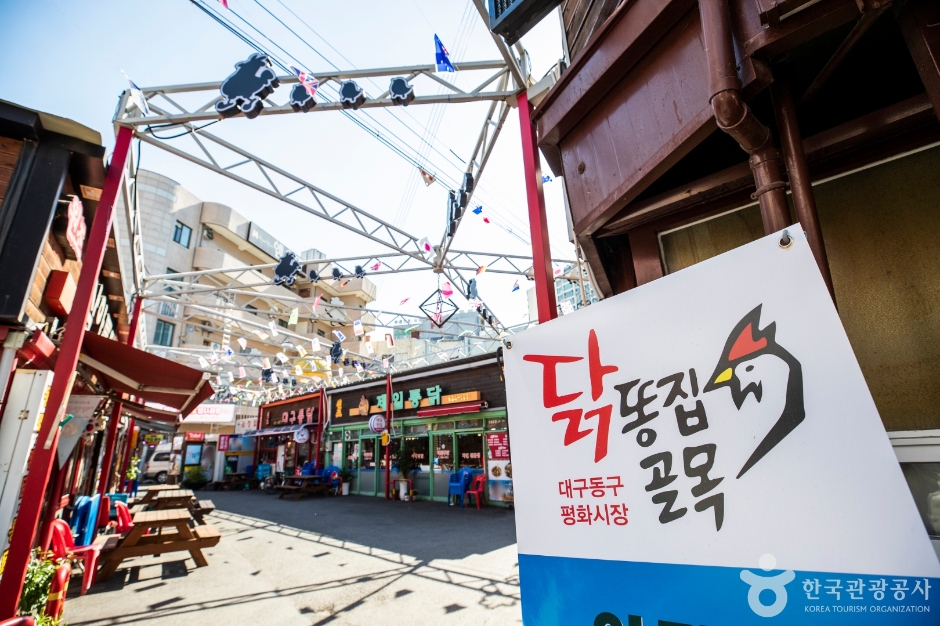
    A street by Daegu's Pyeonghwa Market that specialises in chicken gizzards, which began when the first shop opened here in 1972. The cheap, tasty dish was first sold to workers who gathered at the early-morning job market in front of the market in the 1970s, and it has stayed popular ever since.

    Open 09:00-20:00 (hours vary by shop). Paid public parking is available.

  • Daepo Port Fried Food Alley (속초 대포항 튀김골목)
    Data: Korea Tourism Organization (한국관광공사)
    Sokcho, Gangwon-do

    Daepo Port Fried Food Alley

    속초 대포항 튀김골목

    An alley at Daepo Port, about 10 minutes' drive from downtown Sokcho, known for fresh seafood fritters and local snacks. Stalls fry shrimp, crab, peppers, perilla leaves and sweet potatoes, and also sell port-style squid sundae and sweet-and-spicy braised shrimp. Among the seafood markets and raw-fish restaurants around the port, it is especially popular with younger visitors.

    Hours and closed days vary by stall. Parking is available.

  • Bongsan Gejang Baekban Street (여수 봉산 게장백반거리)
    Data: Korea Tourism Organization (한국관광공사)
    Yeosu, Jeollanam-do

    Bongsan Gejang Baekban Street

    여수 봉산 게장백반거리

    Yeosu's crab street in Bongsan-dong, where restaurants serve gejang baekban: rice and side dishes with crab marinated in soy sauce, one of Yeosu's signature dishes. Fishing boats land their catch close by, so seafood is plentiful all year. As more crab restaurants opened, the area became known as Crab Alley, and it was officially named Gejang Baekban Street in 2009.

    Open all year round; hours vary by restaurant, and some are open 24 hours.

  • Soyangho Makguksu Street (춘천 소양호 막국수거리)
    Data: Korea Tourism Organization (한국관광공사)
    Chuncheon, Gangwon-do

    Soyangho Makguksu Street

    춘천 소양호 막국수거리

    A street of makguksu restaurants near Soyangho Lake. Makguksu noodles are made from coarse buckwheat flour with only the outer husk removed; once served to honoured guests around Chuncheon, they became an everyday food in the hard years after the Korean War. Eat them in cold kimchi or dongchimi broth, or dry with vegetables and seasoning, and add vinegar, mustard or broth to taste.

    Hours and closed days vary by restaurant. A buckwheat pancake (memilbuchim) goes well with the noodles.

  • Hwagae Market (하동 화개장터)
    Data: Korea Tourism Organization (한국관광공사)
    Hadong, Gyeongsangnam-do

    Hwagae Market

    하동 화개장터

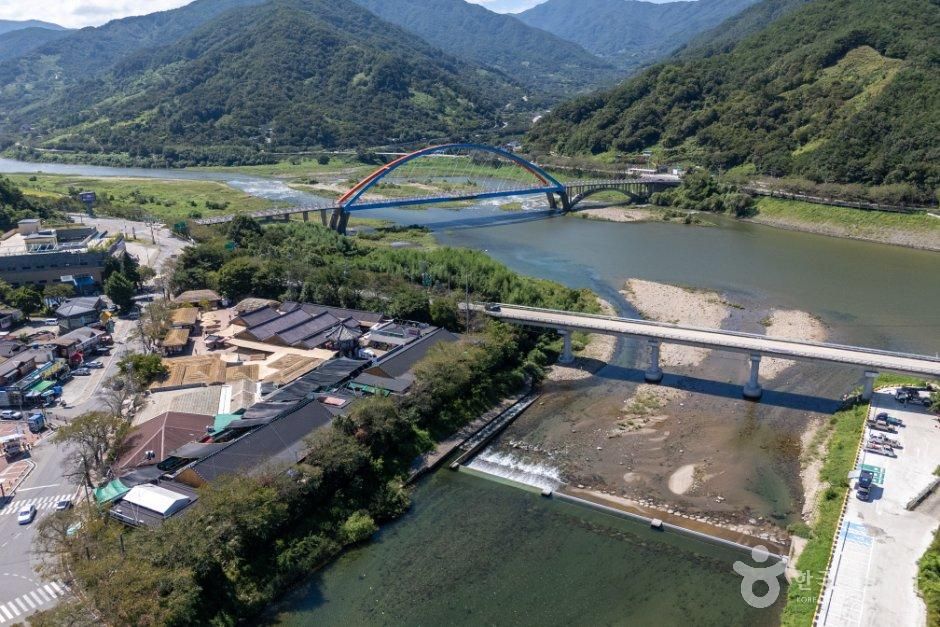
    A market where the Seomjingang River meets Hwagae Stream, where people from the Yeongnam and Honam regions once met to trade. It reopened in 2001 with traditional stalls and a green tea shopping area, and now opens every day instead of only on five-day market days. Browse chestnuts, wild greens, farm produce and medicinal herbs, and try local food as you walk.

    Hours and closed days vary by shop. Parking is available.

  • Jinju Jungang Market (진주중앙시장)
    Data: Korea Tourism Organization (한국관광공사)
    Jinju, Gyeongsangnam-do

    Jinju Jungang Market

    진주중앙시장

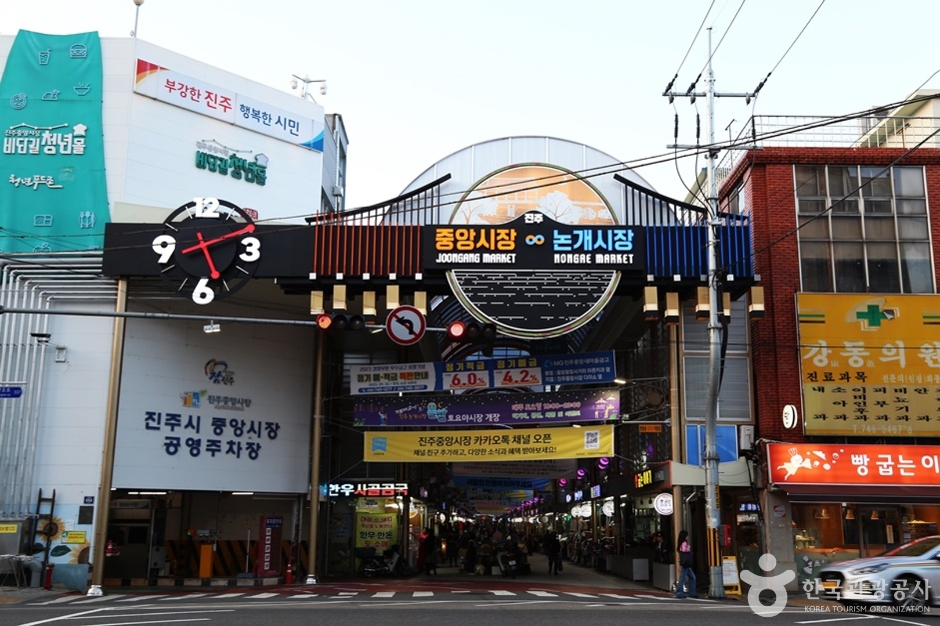
    A long-running market in the heart of Jinju whose roots go back to 1884. Once a five-day market, it now opens every day under a 980 m retractable arcade, with about 850 shops in three sections: hanbok and fabric, food alleys and general goods. A dawn market starts trading early in the morning.

    Open 04:00-22:00 (varies by shop); dawn market 04:00-10:00. Closed on the 1st and 3rd Sundays. Parking is available.

  • Eonyang Market (울산 언양알프스시장)
    Data: Korea Tourism Organization (한국관광공사)
    Ulsan · Ulju-gun

    Eonyang Market

    울산 언양알프스시장

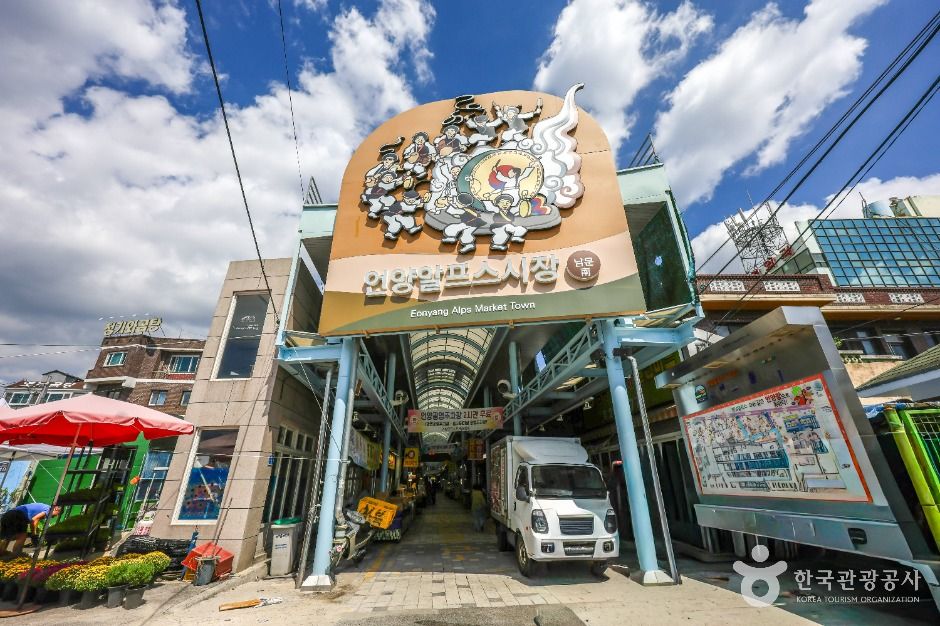
    A market in Eonyang, founded in 1915, that is busiest on five-day market days (dates ending in 2 and 7). It was once called the Seven Towns Market because sellers came from seven nearby areas, and it took its present form about 40 years ago as a general market for food, clothes and everyday goods.

    Open 08:00-19:00, all year round. Market days are the 2nd, 7th, 12th, 17th, 22nd and 27th. Parking is available.

  • Cheongju Yukgeori Market (청주 육거리종합시장)
    Data: Korea Tourism Organization (한국관광공사)
    Cheongju, Chungcheongbuk-do

    Cheongju Yukgeori Market

    청주 육거리종합시장

    Cheongju's best-known traditional market, which began in the Joseon dynasty beside Musimcheon Stream and has been called Yukgeori ("six-way crossroads") Market since 1973. About 4,000 merchants work in some 1,600 shops. Farmers sell their own produce at an early-morning market every day, and a five-day market adds stalls on dates ending in 2 and 7.

    Open 09:00-22:00, all year round. Parking is available.

  • Ulsan Jungang Traditional Market (울산 중앙전통시장)
    Data: Korea Tourism Organization (한국관광공사)
    Ulsan · Jung-gu

    Ulsan Jungang Traditional Market

    울산 중앙전통시장

    Ulsan's central market, which began as Okgyo Market in 1922 and has stayed in the same place ever since. Shops sell wedding goods, curtains, tableware, ritual items and clothing under what is known as the longest market arcade in Korea. In the evening a night market serves almost 30 kinds of food made by former restaurant chefs, cooking teachers and aspiring cooks.

    Night market 19:00-24:00, closed Mondays. The market closes on the 2nd and 4th Mondays; shop hours vary. Parking is available.

  • Gupo Market (구포시장)
    Data: Korea Tourism Organization (한국관광공사)
    Busan · Buk-gu

    Gupo Market

    구포시장

    A large traditional market in Busan that grew up around the old Gupo Ferry on the Nakdonggang River. Permanent shops and a five-day market share the space, so on market days sellers bring in fresh fruit, vegetables and fish, and the lanes feel like an old country market. Many well-known eateries are inside.

    Open 08:00-20:00; days off vary by shop. The five-day market is held on dates ending in 3 and 8. Parking is available.

  • Bupyeong Haemultang Street (부평 해물탕거리)
    Data: Korea Tourism Organization (한국관광공사)
    Incheon · Bupyeong-gu

    Bupyeong Haemultang Street

    부평 해물탕거리

    A street of seafood-stew restaurants in Bupyeong, Incheon. It began 30-40 years ago with just three restaurants and grew as word spread about its haemultang, a rich stew of fresh seafood and aromatic vegetables. Each restaurant has its own flavor, and steamed seafood dishes are popular too.

    Hours and days off vary by restaurant. Haemultang is made for sharing, so it's best with friends.

  • Mokpo Dried Seafood Street (목포 건해산물 거리)
    Data: Korea Tourism Organization (한국관광공사)
    Mokpo, Jeollanam-do

    Mokpo Dried Seafood Street

    목포 건해산물 거리

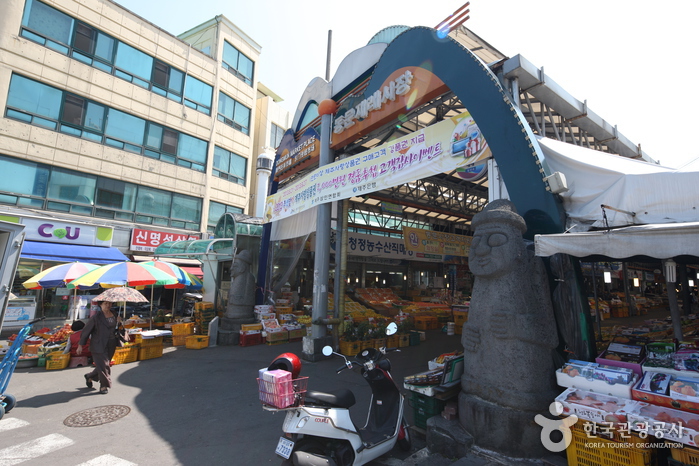
    A street of dried-seafood shops near Mokpo Port, full of the catch of Korea's southern seas: croaker, skate, anchovies, kelp and more. Locals and visitors come to shop here, and many stores let you taste before you buy.

    Hours and days off vary by shop. No parking. Dried seafood keeps well and makes a good gift.

  • Danyang Gugyeong Market (단양구경시장)
    Data: Korea Tourism Organization (한국관광공사)
    Danyang, Chungcheongbuk-do

    Danyang Gugyeong Market

    단양구경시장

    The biggest traditional market in Danyang County. On five-day market days (dates ending in 1 and 6), local elders sell vegetables, beans and wild greens from Sobaeksan Mountain next to old-fashioned goods like brooms and straw bags. Look out for snacks made with Danyang's famous garlic.

    Shops open 09:00-20:00 (varies by store). Five-day market on dates ending in 1 and 6. Parking is available.

  • Masan Fish Market (마산어시장)
    Data: Korea Tourism Organization (한국관광공사)
    Changwon, Gyeongsangnam-do

    Masan Fish Market

    마산어시장

    A big seafood market in Masan, Changwon, with about 200 raw-fish restaurants and tanks of fish from the clean waters of the South Sea, from premium fish to mackerel and pollock. Dried and salted seafood is sold at reasonable prices, and the market has modern arcades.

    Open 10:00-22:00 (varies by store). Parking is available.

  • Namgwangju Market (남광주시장)
    Data: Korea Tourism Organization (한국관광공사)
    Gwangju · Dong-gu

    Namgwangju Market

    남광주시장

    A market that grew up around the old Namgwangju Station in Gwangju. The station has closed, but the market is still famous for fresh fish, which arrives every morning between 2 and 5 a.m., so the raw-fish restaurants around it serve very fresh fish at affordable prices.

    Closed the 1st and 3rd Sundays of each month; shop hours vary. Parking and restrooms are available. Come early in the morning for the freshest fish.

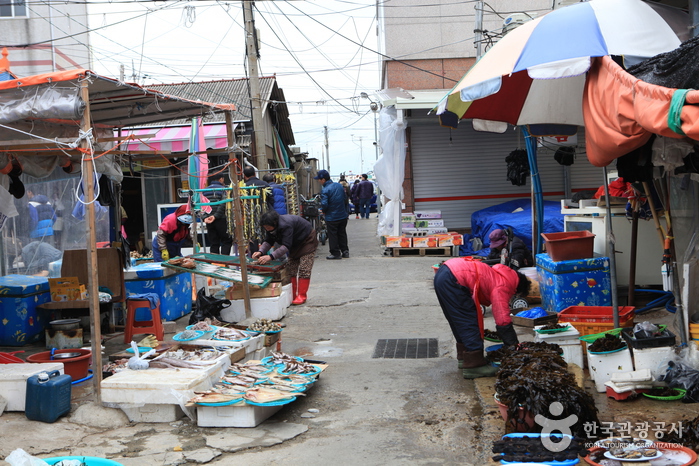
  • Guryongpo Five-Day Market (구룡포 오일장)
    Data: Korea Tourism Organization (한국관광공사)
    Pohang, Gyeongsangbuk-do

    Guryongpo Five-Day Market

    구룡포 오일장

    A five-day market by Guryongpo Port in Pohang. On market days the stalls spread all the way to Changjucheon Stream. It began when a village formed around the port and boomed in the 1950s and '60s; today rows of seafood restaurants draw seafood lovers, and stalls sell squid, Pacific saury, abalone and flatfish.

    Market days are the 3rd, 8th, 13th, 18th, 23rd and 28th of each month. Shop hours vary.

  • Seomun Market Samgyeopsal Street (청주 서문시장 삼겹살거리)
    Data: Korea Tourism Organization (한국관광공사)
    Cheongju, Chungcheongbuk-do

    Seomun Market Samgyeopsal Street

    청주 서문시장 삼겹살거리

    A street of grilled pork belly restaurants in Seomun Market, Cheongju, opened in 2012. Cheongju-style samgyeopsal is a local specialty, made with a way of preparing the meat that has been passed down through generations. The Seomun Pungmul Night Market is held here too.

    Hours and days off vary by restaurant. Parking is available.

  • Suncheon Aretjang Market (순천 아랫장)
    Data: Korea Tourism Organization (한국관광공사)
    Suncheon, Jeollanam-do

    Suncheon Aretjang Market

    순천 아랫장

    A traditional market less than 1 km from KTX Suncheon Station, known as the largest five-day market in Korea. On market days it fills with fresh farm and sea produce from Suncheon and nearby areas, and on Friday and Saturday evenings a night market serves snacks, savory pancakes, fried chicken and more.

    Open 05:00-18:00. Five-day market on the 2nd, 7th, 12th, 17th, 22nd and 27th. Night market on Fridays and Saturdays. Parking and restrooms are available.

  • Wonju Jungang Market (원주 중앙시장)
    Data: Korea Tourism Organization (한국관광공사)
    Wonju, Gangwon-do

    Wonju Jungang Market

    원주 중앙시장

    A market in central Wonju that began as a five-day market in the 1950s and now opens every day, with about 370 shops and a food street of restaurants side by side. On the second floor, the Maze Art Market has winding lanes of small design shops and eateries; the market was named a cultural market in 2015.

    Shop hours vary. Restrooms are on the 2nd floor. Head upstairs to explore the Maze Art Market.

  • 1913 Songjeong Station Market (1913송정역시장)
    Data: Korea Tourism Organization (한국관광공사)
    Gwangju · Gwangsan-gu

    1913 Songjeong Station Market

    1913송정역시장

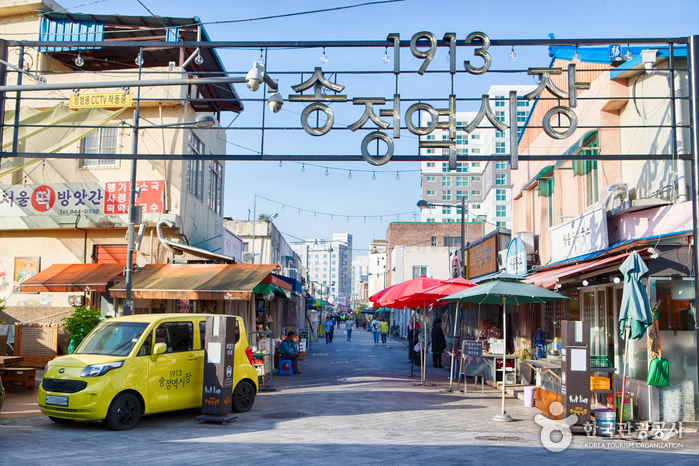
    A market that opened in 1913 together with Songjeong Station and was redesigned around the theme of time when it reopened in 2016. It sits right across the street from Gwangju-Songjeong KTX Station, and its shop signs tell each shop's history. Stop by for classic market snacks before or after a train ride.

    Open 11:00-22:00 (Mon-Thu) and 11:00-23:00 (Fri-Sun). Closed on the 2nd and 4th Mondays. Public parking nearby.

  • Euljiro Nogari Alley (을지로 노가리골목)
    Data: Korea Tourism Organization (한국관광공사)
    Seoul · Jung-gu

    Euljiro Nogari Alley

    을지로 노가리골목

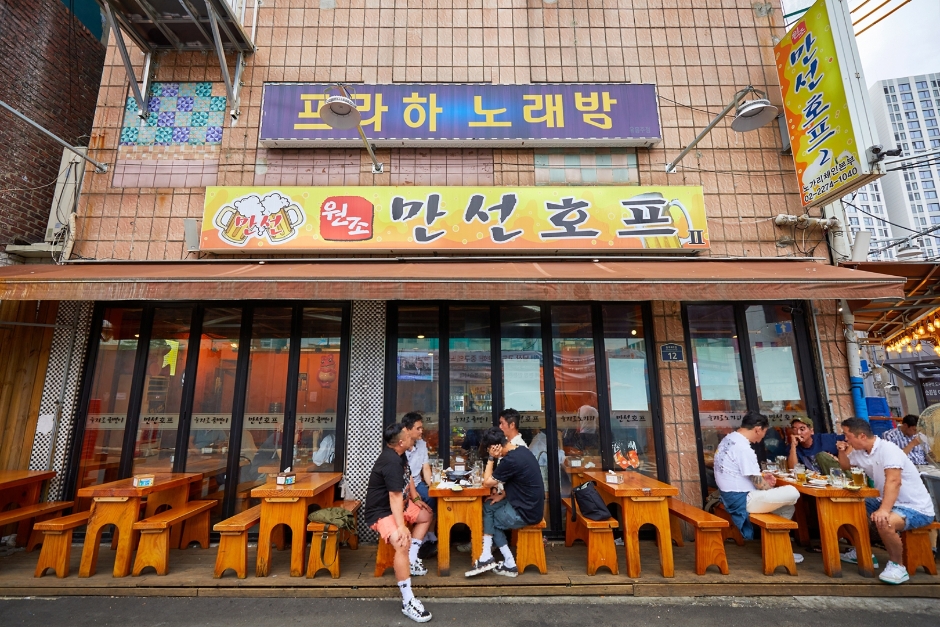
    An alley of small pubs near Euljiro 3-ga Station, among old tool shops and offices. The classic order is nogari, dried young pollack grilled and dipped in red pepper paste, with a glass of beer, or spicy sea snail salad with thin noodles. On weekday evenings and weekends tables fill the alley and seats are hard to find.

    Euljiro 3-ga Station (Line 3), Exit 3. Hours vary by pub. No parking.

  • Gyeongju Ssambap Street (경주 쌈밥거리)
    Data: Korea Tourism Organization (한국관광공사)
    Gyeongju, Gyeongsangbuk-do

    Gyeongju Ssambap Street

    경주 쌈밥거리

    A street of restaurants beside the Daereungwon tomb park serving ssambap: fresh leafy vegetables for wrapping rice, with side dishes such as fish and meat and a stew made with homemade soybean paste. Snack shops sell Hwangnam bread, filled with red bean paste, and jjondeugi, a chewy sweet made from cornmeal. Cheomseongdae Observatory and Donggung Palace and Wolji Pond are a short walk away.

    Next to Daereungwon. Hours vary by restaurant. Parking is available.

  • Tongyeong Kkulppang (Honey Bread) Street (통영항 꿀빵거리)
    Data: Korea Tourism Organization (한국관광공사)
    Tongyeong, Gyeongsangnam-do

    Tongyeong Kkulppang (Honey Bread) Street

    통영항 꿀빵거리

    A street by Tongyeong Port and Jungang Market lined with shops selling kkulppang, Tongyeong's signature sweet. The dough is filled with sweet red bean paste, deep-fried and coated with honey; it was first made in the 1960s as a snack that kept well for sailors in the warm coastal weather. Dongpirang Village and Sebyeonggwan Hall are nearby.

    Near Tongyeong Port. Open all year round; shop hours vary.

  • Suwon Nammun Market (수원 남문시장)
    Data: Korea Tourism Organization (한국관광공사)
    Suwon, Gyeonggi-do

    Suwon Nammun Market

    수원 남문시장

    The largest traditional market area in Gyeonggi-do: nine connected markets around Paldalmun Gate, including Jidong, Paldalmun, Motgol and Nammun Rodeo markets. Its roots go back to King Jeongjo's reign, when a permanent market opened inside Hwaseong Fortress and a five-day market was held outside Paldalmun Gate.

    Open all year round; hours vary by shop. Parking is available.

  • Gongju Sanseong Market (공주산성시장)
    Data: Korea Tourism Organization (한국관광공사)
    Gongju, Chungcheongnam-do

    Gongju Sanseong Market

    공주산성시장

    A big market from 1937 under an arcade roof, close to Gongju National Museum, Gongsanseong Fortress and the Tomb of King Muryeong. Its food alley offers gimbap, banquet noodles and bulgogi, and don't miss Gongju's chestnut specialties: chestnut makgeolli and chestnut rice cakes made with local chestnuts.

    Hours vary by shop. Parking is available.

  • Yeongwol Seobu Morning Market (영월 서부아침시장)
    Data: Korea Tourism Organization (한국관광공사)
    Yeongwol, Gangwon-do

    Yeongwol Seobu Morning Market

    영월 서부아침시장

    A downtown market in Yeongwol since 1959. As the name says, it was a morning market: farmers came at dawn to sell their produce and went back to the fields at noon. Local farm goods are still sold here, and the market is known for its row of shops making wheat and buckwheat pancakes, and for sweet crispy fried chicken (dakgangjeong).

    Hours vary by shop.

  • Sehwa Five-Day Market (세화민속오일시장)
    Data: Korea Tourism Organization (한국관광공사)
    Jeju · Gujwa-eup

    Sehwa Five-Day Market

    세화민속오일시장

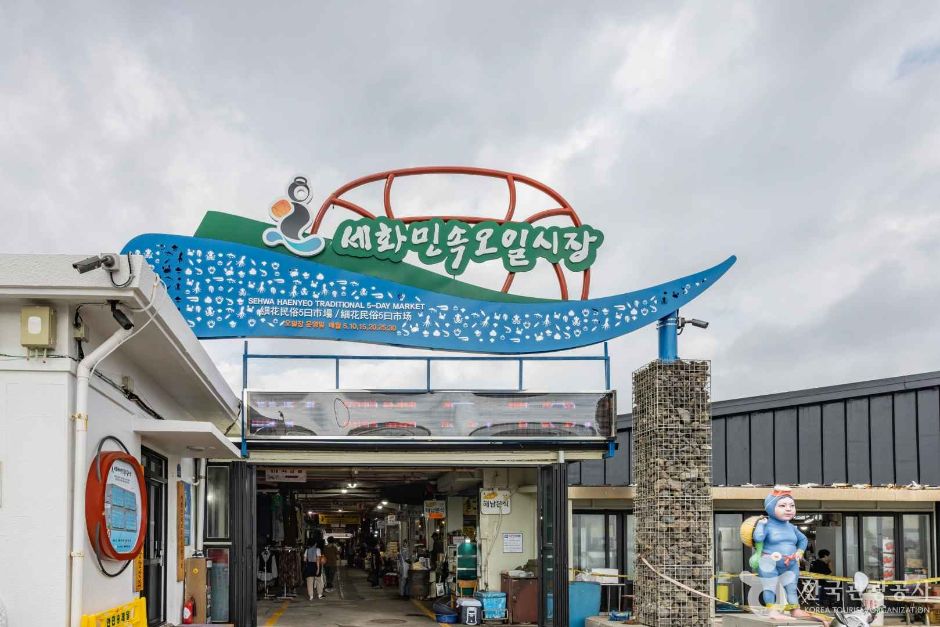
    One of the biggest five-day markets in eastern Jeju, open only on days ending in 5 or 0. It is busiest before noon, and many stalls close by 14:00. Look for Jeju seafood, fruit and vegetables, side dishes and snack stalls with tteokbokki, then walk to Sehwa Beach right next door.

    Open on days ending in 5 or 0, about 08:00-14:00 (varies by stall). Parking is available.

  • Dangmeori Hamo Street (여수 당머리하모거리)
    Data: Korea Tourism Organization (한국관광공사)
    Yeosu, Jeollanam-do

    Dangmeori Hamo Street

    여수 당머리하모거리

    A street of restaurants in Yeosu, a port city known for eel dishes, specializing in hamo (pike conger eel). It is best from mid-April to late October, after feeding in the clean waters of Korea's south coast. Try it as shabu-shabu, salt-grilled, grilled with soybean paste or spicy red pepper paste, or in a cold raw-fish soup (mulhoe).

    Hamo season: mid-April to late October. Hours vary by restaurant. Parking is available.

  • Yangyang Traditional Market (양양전통시장)
    Data: Korea Tourism Organization (한국관광공사)
    Yangyang, Gangwon-do

    Yangyang Traditional Market

    양양전통시장

    Yangyang lies where Seoraksan and Odaesan mountains meet the East Sea, so goods from the mountains and from the coast have long been traded here. The market has a five-day market on dates ending in 4 and 9, and what you find changes with the seasons.

    Five-day market on dates ending in 4 and 9; shop hours vary. Parking and restrooms are available.

Data: Korea Tourism Organization (한국관광공사), via TourAPI. Photos are shown as provided, uncropped. Facts are checked against VisitKorea and official festival sites, and the descriptions are our own. Dates can change, so check the official site before you travel.